
Medicare Advantage vs. Medicare Supplement: Which Is Right After a Nursing Home Stay?
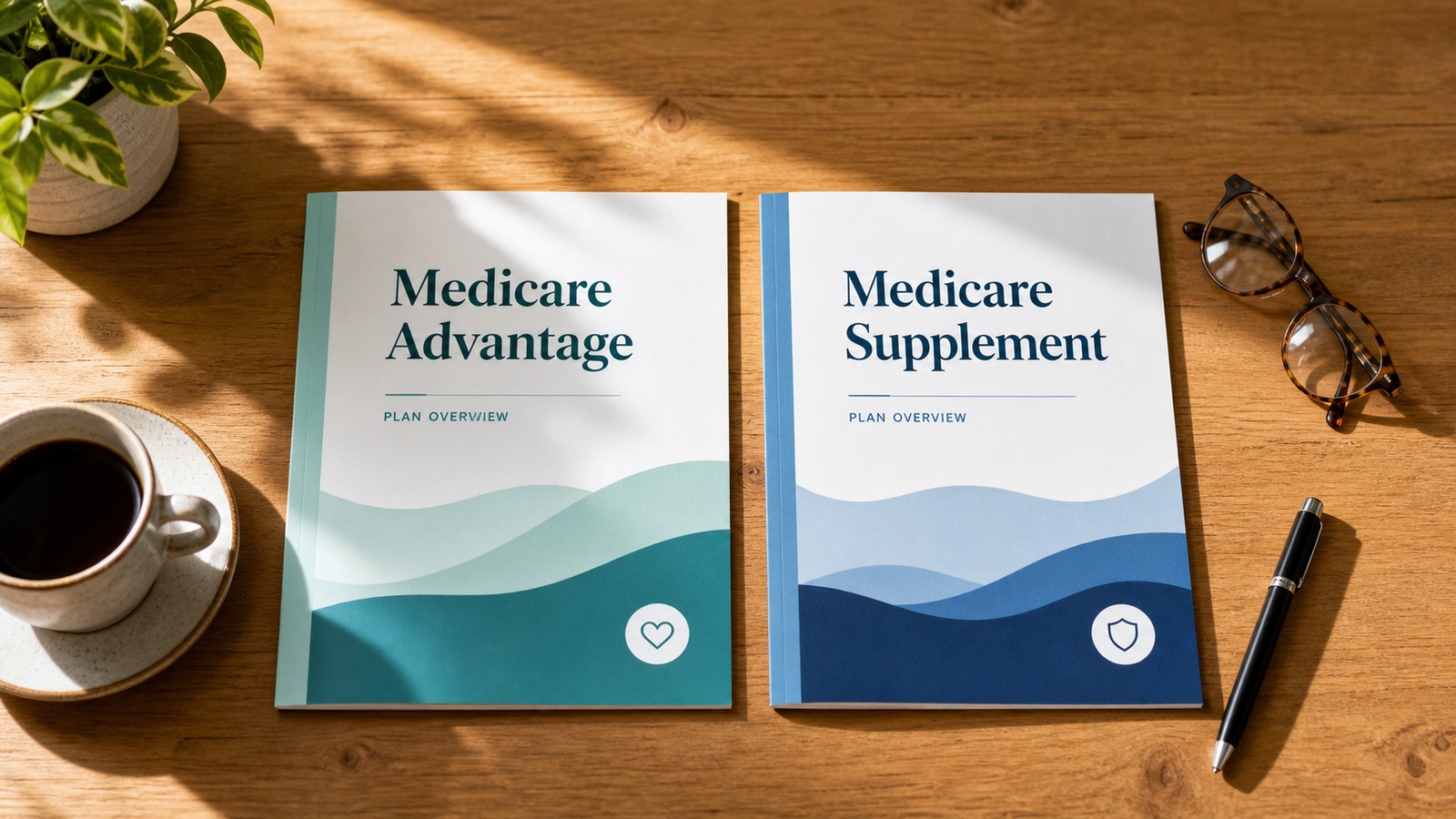
Two very different plan types, two very different answers depending on your situation. Here's how to think about the trade-offs.
If a parent or spouse is recovering from a nursing home stay, the question of “what kind of Medicare should they go back to?” lands at the worst possible moment. Discharge papers are flying around, a home health agency is calling about scheduling, and someone has handed you a folder with three different plan letters in it. The decision in front of you — between Medicare Advantage (sometimes called Part C) and a Medicare Supplement (Medigap) policy paired with Original Medicare — will shape what doctors are available, what every appointment costs, and how much paperwork your family handles for the next year.
There isn't a universally “right” answer. The right plan depends on the kind of care that's likely to come next, how much risk a household can absorb in a bad month, and whether the patient is well enough to handle prior-authorization paperwork or needs someone else managing it. Here's how to think it through.
Why this decision matters more after a SNF stay
Most Medicare decisions are made once a year, in October or November, with months of breathing room. A post-discharge decision is the opposite. The patient is often still adjusting to a new medication list, a new mobility baseline, and a new care team. The next 90 days are likely to involve more medical contact — physical therapy, home health, follow-up imaging, specialist visits — than any 90-day window before the SNF stay. That means the plan's rules around networks, referrals, prior authorization, and out-of-pocket costs aren't theoretical. They will be tested almost immediately.
It also matters because some doors are about to close. A short Special Enrollment Period may be open. Medigap guaranteed-issue rights, if they exist for this patient, may be on a 63-day clock. Treating the decision as “something we'll figure out next month” is the most common mistake we see.
A quick refresher on the two paths
Original Medicare is the federal program: Part A for hospital care and skilled nursing, Part B for doctor visits and outpatient services. It lets the beneficiary see any provider in the country who accepts Medicare. It doesn't include prescription drug coverage, so most people add a Part D plan. And because it leaves a percentage of cost on the patient (20% of most Part B services, with no out-of-pocket maximum), most people also buy a Medicare Supplement (Medigap) policy to fill the gap.
Medicare Advantage is private insurance that replaces the way Original Medicare delivers benefits. The carrier — Aetna, Humana, UnitedHealthcare, Wellcare, Cigna, Clover, or others — administers Parts A and B, usually bundles Part D, and adds extras like dental, vision, hearing, fitness benefits, and over-the-counter allowances. Advantage plans typically have provider networks (HMO or PPO), prior-authorization requirements, and an annual out-of-pocket maximum that Original Medicare does not have.
How each handles the post-nursing-home period
After a skilled nursing facility (SNF) discharge, the next phase of care usually includes some combination of home health visits, follow-up appointments with specialists, prescription refills, and possibly outpatient rehab. The two systems treat that phase differently.
With Original Medicare plus a Medigap policy, most of the post-discharge cost is predictable. After the Part B deductible, Medicare pays 80% of approved charges; the Medigap policy typically pays the other 20%. Home health, when ordered correctly, is fully covered. Visits to any Medicare-accepting therapist or specialist don't require a referral. The patient or family does not generally deal with prior-authorization paperwork on individual visits, which matters when the household already has a stack of paperwork from the SNF stay.
With Medicare Advantage, the experience depends heavily on the specific plan and how its network is structured. Many post-discharge services — durable medical equipment, certain outpatient therapies, home health authorizations — require prior approval from the plan. The carrier may direct care to specific in-network home health agencies. Co-pays apply per visit and per specialist. There is also an out-of-pocket maximum, which is a real protection if the year turns out to be expensive — once it's hit, the plan pays 100% of in-network covered services.
When Medicare Advantage usually fits better
Medicare Advantage tends to work well for someone who is recovering predictably, lives in an area with strong in-network options, takes prescriptions that are well-covered on the plan's formulary, and either values the added benefits (dental, vision, OTC allowance) or wants the lower monthly cost. The capped out-of-pocket maximum is meaningful for households that could not comfortably absorb tens of thousands of dollars in uncovered care.
It can also be a good fit when an Advantage plan's preferred network includes the rehab agency, the primary care physician, and the cardiologist or pulmonologist the patient already sees. If the plan already covers the right people, the network restriction is not a real restriction.
When a Medigap policy usually fits better
A Medicare Supplement (Medigap) plan tends to fit best when the patient travels for care, sees specialists outside the local area, or has a complex condition where the answer is “we don't know what kind of provider you'll need next.” With Medigap, any Medicare-enrolled provider in the country is in-network. There are no referrals and very few prior authorizations. Cost predictability is high — most plans, like Plan G, leave the beneficiary owing only the small annual Part B deductible.
The trade-off is the monthly premium, which can run from roughly $120 to $300 depending on age, state, and plan letter. For someone with multiple specialists, frequent appointments, or anxiety about surprise bills, that premium often buys real peace of mind.
A word about switching
A common misconception is that the patient can move freely between Advantage and Medigap. They can't. Medicare Advantage has set enrollment windows: the Open Enrollment Period (October 15 – December 7), the Medicare Advantage Open Enrollment Period (January 1 – March 31), and Special Enrollment Periods triggered by qualifying events.
The Medigap side is less flexible than people expect. There is a one-time, six-month Medigap Open Enrollment window when the beneficiary first enrolls in Part B at age 65, during which carriers cannot deny coverage or charge more based on health. After that, in most states, a Medigap carrier can medically underwrite — and a patient who has just been through a SNF stay may be declined or charged a higher rate. A handful of states have broader guaranteed-issue protections; most do not, outside specific circumstances.
This is the single most important piece of information a family can have before making a “which way do we go?” decision after a nursing home stay: timing matters, and dropping a Medigap policy to try Advantage is a decision that may not be reversible.
Drug coverage: the line item that decides more cases than people expect
For a patient leaving a skilled nursing facility, the medication list has usually grown. New prescriptions are common: anticoagulants after an inpatient cardiovascular event, antibiotics finishing up, gabapentin or other pain management, an SGLT2 inhibitor or DOAC that the hospitalist started during admission. Each of those medications has a tier and a copay structure inside whatever drug plan the patient ends up with.
Medicare Advantage plans usually bundle Part D. Original Medicare with Medigap requires a separate stand-alone Part D plan. Either way, the plan's formulary — the list of covered drugs — is what determines the real cost. A medication that's tier 2 on one plan can be tier 4 (specialty) on another, with a difference of hundreds of dollars a month. Before signing anything, run the post-discharge medication list, with dosages, against the plan's formulary. We do this for every client at this stage; it changes the answer roughly a third of the time.
The total-cost math people miss
Comparing premiums alone almost always points to Medicare Advantage — many plans have $0 premiums. Comparing total annual costs in a moderate-utilization year often points to Medigap. The full math includes:
- Monthly premium (plan + Medigap + Part D, depending on the route).
- The Part B premium, which both routes pay.
- Expected copays — primary care, specialist, urgent care, imaging, therapy sessions, durable medical equipment.
- Expected drug costs across the full year, including deductible and coverage phases.
- The plan's maximum out-of-pocket exposure if the year goes badly.
A real comparison rarely fits on one page. It belongs in a spreadsheet, with a base-case and a bad-case column. The plan that wins on the base-case column may not be the plan that wins on the bad-case column. Households differ on which one matters more, and that's a legitimate judgment call — not a math error.
Five questions to ask before deciding
- Who are the patient's must-keep providers, and are they in the Advantage plan's network?
- What does the patient's daily and weekly cost look like under each plan in a typical month — and in a bad month?
- How comfortable is the household with handling prior-authorization paperwork?
- Does the patient travel — to other states, to family, to second homes — and need coverage there?
- Is the patient still inside any guaranteed-issue Medigap window, or would switching require medical underwriting?
Three realistic scenarios
It can help to see how the same trade-offs play out for different households. These are composite scenarios, not real clients, but the patterns reflect what we see week to week.
Scenario one: a 78-year-old recovering from a hip replacement. Lives alone, doesn't travel, sees a primary care physician and an orthopedist locally. Takes four prescriptions, all generic, all on most formularies. Has a small fixed income with modest savings. For this profile, a well-chosen Medicare Advantage plan with a low maximum out-of-pocket, the right local network, and zero or low premium often wins on total cost. The added dental and OTC allowances are real value. The capped out-of-pocket maximum is the safety net that matters.
Scenario two: a 71-year-old with congestive heart failure and three specialists. Sees a cardiologist twice a year, plus a pulmonologist, plus a nephrologist. One of those specialists is at an academic medical center forty minutes away. Travels in the winter to be near grandchildren in another state. For this profile, Original Medicare with a Medigap policy and a stand-alone Part D plan usually wins. Any Medicare-enrolled provider in the country is in-network. No referrals. Prior authorizations are rare. The higher monthly premium is a real cost, but for someone with high utilization and complex needs, it is usually the lowest-stress and most-predictable path.
Scenario three: a 73-year-old leaving a long-term care facility after a fall recovery. Going home with a new medication list, weekly home health visits, and outpatient PT three times a week for the next two months. The household needs both predictability and flexibility. The decision usually hinges on whether Medigap underwriting will accept the patient given the recent stay. If a guaranteed-issue right is available, Original Medicare plus Medigap plus Part D becomes a strong option. If not, the right Medicare Advantage plan — chosen carefully for its home health partners and rehab network — may be the practical answer.
What about D-SNPs and dual-eligible plans?
If the patient qualifies for both Medicare and Medicaid (sometimes called “dual-eligible”), a different set of plans becomes available: Dual Eligible Special Needs Plans (D-SNPs). These are a type of Medicare Advantage plan designed specifically for people on both programs. They typically have $0 premiums, $0 or very low copays, and supplemental benefits — meal delivery, transportation, larger OTC allowances — sized for people on fixed incomes.
D-SNPs aren't automatically the right answer for every dual-eligible patient. The same network and prior-authorization questions apply. But they should be on the table in any conversation where Medicaid is part of the picture, and the comparison should run alongside any traditional Advantage or Medigap option. Carebridge advisors are trained on this overlap and coordinate carefully with state Medicaid programs and the New Jersey State Health Insurance Assistance Program (SHIP) when questions arise.
How Carebridge thinks about it
We don't pre-decide which side a client should land on. We sit with the family, pull the medication list, the doctor list, and the actual benefit summaries from the plans on the table, and we run through the realistic next year. Most of the time the right answer becomes obvious once the numbers are on paper. If we're licensed in your state, we'll help you compare both sides — and if the timing matters for a Medigap decision, we'll tell you so before the window closes.
Have a question this guide didn't answer?
Ask us directly. We'll point you to the right answer — or write a guide if it's a question we hear often.